Thursday, 11 February 2016

Mega ST : Revival pt.1

This blog tends to randomly wake up and set off on new tangents, and here comes another one....

A few years ago I heroically saved an Atari Mega ST 4 from almost certain doom, as it was about to be disposed of from a huge uncaring bureaucratic institution where I happened to work. Getting it up and running and exploring what it's capable of in the 21st Century has been an interesting process, so the next few posts will describe what I've been up to, just in case it might be interesting and/or useful.

Growing up I cut my teeth (not literally, ouch) on an Atari STe, so I have a real fondness for the Atari platform. Letting the Mega go to waste would have been a crime! Plus, this machine came with a 50Mb Protar hard drive, which was the stuff of dreams back in the day.
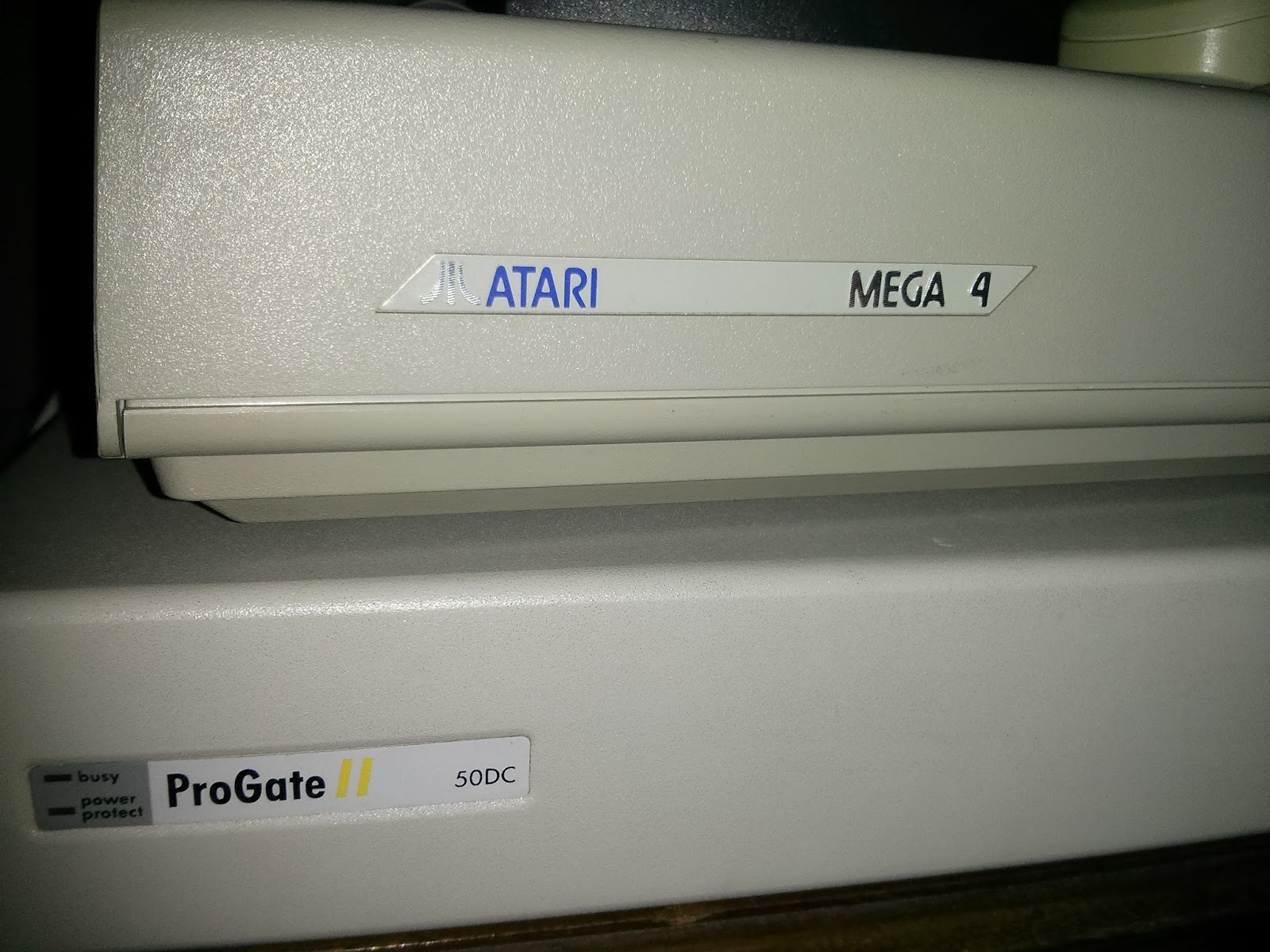
Bringing it back to life was always going to be easier said than done. In the first rush of enthusiasm I cleaned it up, inside and out and it all appeared to be working fine. I bought an RGB to SCART adapter so I could hook it up to a modern(ish) TV, and invested in an EtherNEC box, which at that time appeared to offer the best hope for being able to easily transfer files to and from modern machines. However, this really required a hard drive - and my inherited hard drive had all of its partitions password protected and any people who might have originally known them were all long gone (not dead, just... not around any more)

So, my first attempts faltered. I had no way of accessing the hard drive and no drivers or tools to wipe it and start again. I found a few tools online that might have helped, but transferring them onto floppies was a painstaking process and when they didn't work my enthusiasm slowly ebbed away.

Fast forward to late 2015 and I decided it was about time to dig it out again and make a serious attempt at getting it all up and running.

Key to this process was my discovery, via AtariCrypt and the wonderful Atari-Forum, of Petr Stehlik's PARCP-USB device, which allows an ST to connect to a PC, Mac or Linux machine via USB and quickly transfer files back and forth.

After a long search this thread gave me the Protar drivers I needed for the ProGate 50DC. Using the PARCP-USB adapter I was able to transfer the utilities, update the driver and then format and re-partition the hard drive. I now had 50 whole megabytes of storage to play with! Unimaginable :-)

With that accomplished I had a few goals in mind. The first was to get the EtherNEC box working and find out whether a 30-year old Atari ST could connect to the internet successfully and do anything useful or interesting.

I also had a project in mind to back up a lot of old floppy disks that had been stored away since my STe days, before they succumb to bit-rot and the other perils of ageing magnetic media.

Plus, I also wanted to investigate a strange and intriguing expansion card that I found inside when I first opened up the Mega...

Over the next couple of posts I'll detail some of my experiences setting up the machine, getting it connected to the Internet, and beyond!

Monday, 19 May 2014

#ocTEL Into a routine

I've been settling into ocTEL and a routine of only dipping into what I need to (and can realistically achieve)

I realised quite quickly that as I'm at an early stage of my career in Learning Technology I don't have the same practice experience that others do, or much knowledge of methods and strategies and frameworks, but it's been really interesting to 'eavesdrop' on some of the discussions in the forums and elsewhere.

I think one of the tricky things to deal with (for me anyway) on an open and less structured course like this is the feeling of "being behind". With so much to read and posts continually coming in, I've had to constantly remind myself that it's ok to stop reading and take time to review what I've learned and think reflectively (and critically).

The 'badges' on offer are a great incentive, but at the same time I need to remind myself that not necessarily achieving every single one is ok too :)

Over the last week I enjoyed looking at the Pre-Course Questionnaires, and thinking critically about my own readiness and approach to learning.

I initially chose this questionnaire, as it seemed to be more in-depth than some, and offered more choices than just yes or no:

University of Houston - Distance Education
http://distance.uh.edu/online_learning.html

Although I scored highly on the computer skills areas, I ended up in the 'almost there' category, which I suppose was something of a surprise. Perhaps I was being cautious with my answers, or perhaps (more likely) I genuinely do need to work on preparing for any online learning I might do. Certainly it's been some time since I did any serious study myself, so I'm sure there are some "academic skills" I could do with brushing up on. So, in a way, that outcome has been a positive one, as it's made me take some time to reflect on this and work out how to improve these skills.

I like the idea that a pre-course questionnaire can be for the benefit of both the institution (to gain an insight into the capabilities and potential needs of students-to-be) but also for the potential student (to give them constructive suggestions and pointers about which areas they might need to pay extra attention)

I suppose what struck me most overall was that the questionnaires could easily have been tweaked (and only slightly!) to apply to 'traditional' on-campus courses. I wonder how many Colleges and Universties take into account things like IT literacy, independent study skills and time management skills when preparing to admit undergraduates or postgraduates to face to face courses?

Sunday, 4 May 2014

#ocTEL Week 0 thoughts

Over the next couple of months I'm going to attempt to flout all the basic laws of time and space by participating in the Open Course for Technology Enhanced Learning (ocTEL), run by the nice people at the Association for Learning Technology.

ocTEL logo

I participated in the second run of the EDCMOOC last November and although I enjoyed it, I found it hard to keep up with all the various discussions and diversions and groups that formed and morphed and spread out.

Perhaps I relied a bit too much on Twitter. It's very easy to get disheartened when everyone seems so far ahead in their thinking, and I think Twitter heightened this feeling for me. (For some reason, right from the get-go, EVERYONE seems to be much further advanced on Twitter!)

I found it interesting just how much my perception of my own progress and accomplishment relied on interaction and feedback from others. Getting a comment on a blog post seemed to validate it, somehow, whereas a post or a tweet that went seemingly unnoticed was really disheartening. Obviously in course with such a huge membership there's no way to guarantee interaction, but when the whole premise of the cMOOC relies on connectivity and peer-learning - and on each participant being brave and putting stuff out there into the big wide webby world - it's bound to be disheartening when silence is the result.

I did find myself considering giving up on the EDCMOOC before the last couple of weeks when I got my teeth into the practical element of creating the final assessment piece, and this spurred me on to complete the course.

This time, I hope that setting some learning goals will help - both to reduce the pressure I put on myself, but also to keep me focused on getting what I want out of the experience.

I also like the idea of forming small groups for reflection and discussion, in order to keep things manageable.

Activity 0.1 Big and Little questions

I'm not sure I have one 'Big Question' I'm looking to find answers or ideas about. I'm still at an early stage in my career in Learning Technology, so I feel I have lots of listening and reading to do. That might seem like a cop-out!

I suppose if I had to pick one area of particular interest, it would be around video and audio, and creating media content in and around TEL. That's quite a wide area, but by that I would include opportunities for collaborative work on such content, perhaps in innovative ways over the web - perhaps I'll blog about this later.

Thursday, 14 November 2013

#edcmooc The Teacher as Technologist?


The first two videos posted for us by the EDCMOOC folks this week come from corporate sources, showing how their products might shape the future of learning.

The first thing that sprang to my mind when watching them was the extent to which the film Minority Report continues to influence visions of future technology. It was released eleven years ago (really?!) and since then we've come some way down the path of touchscreens (tablets, smartphones) and movement-controlled devices (Kinect) but never really got to the point of those amazing, fluid, interactive 3D walls, allowing multiple users to call up and engage with any content (all beautifully rendered), seemingly from any and all possible sources.

It's interesting that tech companies are still inspired by parts of what was certainly a dystopian story. And they still see - and project - this vision for Human Computer Interaction in particular, as a goal that they (and society as a whole) should be striving for.

There's a great article about the lasting effects of Minority Report on the people who've shaped technology over the last decade, over at 'Overthinking It'. There's definitely an interesting debate to be had about whether popular culture predicts technological advancements or whether, conversely, technological advancement is inspired and driven by popular culture.

For me it's not so much a question of whether the visions Intel and Corning are setting out are utopian or dystopian - there are clearly positives and negatives to be taken from them both. My immediate reaction was about how the 'systems' they suggest could work, practically, away from the glossy, manufactured sheen of the advertising film, and what the implications might be if, to whatever extent, the realities fell short of the ideals.

Films - and advertising films especially - are, of course, by nature not balanced and objective. So we must think about the kinds of things these two companies are suggesting and try to work out whether they would actually be practical - or desirable - in the kinds of educational settings we are familiar with today.

One thing which struck me is the extent to which advances in technology could force teachers and academics to become technologists - experts in technology rather than simply experts in their particular field.

What is the fate for those who refuse to (or simply cannot) go along this path? And what knowledge and experience could learners miss out on because of this?

I'm familiar with some of the challenges posed by current online learning technology. Uploading text documents - never mind audio and video or complex multimedia content - to a relatively straight-forward web-based VLE system can be difficult for some. Much of the learning experience for the learner crucially depends on the degree of digital literacy of the teacher or academic.

Looking at the beautiful table-top and interactive wall displays in the Corning video, my thought was "Who is going to create and manage all this content?". Does this vision suggest that the teacher will in future need to be graphic designer, data architect, content curator, computer programmer?

The other question that struck me was how much freedom and creativity in teaching might actually be restrained by the use of such technology, in the sense that the tools available to the teacher might restrict what can and can't be taught, or the way in which that knowledge can be presented.

In this new 'system', which canonical sources are used for the core information, which websites can and can't be trawled for images of bridges, which tablets and software will be compatible? And who decides this kind of thing? The teacher or the company supplying and installing the technology?

The role of corporations in education is something that is often provokes controversy. The feeling that large companies might be gaining some measure of control over education at the expense of teachers and local authorities, however innocuous it might seem, would likely be resisted by many.

That's not to say that there aren't positives for me in all this. The possibilities for the use of 3D printing technology in the classroom are exciting. And the idea of better real-time connectivity between the bubble of the classroom and the people and places in the world outside certainly has potential.

But bringing it all together in a workable way - and for the good of the learner - is a big challenge.

Thursday, 7 November 2013

#edcmooc The Victorian Internet


Tom Standage, "The Victorian Internet" (1999)

http://books.google.co.uk/books?id=w_oTLDzVEXsC


I read this book a couple of years ago and thoroughly enjoyed it. It was published in 1999, before the dotcom bubble burst and the rise of Web 2.0 and before current thinking and practice around online learning had really got going.

But still, it provides a fascinating insight into the development of the telegraph, the disruptive impact it had on society and culture and the fears its spread elicited.

It's intriguing to note how many of these same debates were, and are, being repeated in the Internet age. Some of the parallels are fascinating and suggest that many of the debates we are having aren't quite as original as we might think...

Wednesday, 6 November 2013

#edcmooc Technology and education - sacred cows?


This is a nice animation, the first required viewing for the #EDCMOOC

It got me thinking about how the history of both education and technology, and how both have been treated - almost worshipped - and kept sacred.

It's not so long ago that education itself was reserved for the elite. It was protected, kept away from those deemed unworthy. Religious learning - perhaps the precursor to modern formal education - was for a long time kept in the Latin language only known to the powerful and learned, to be controlled and meted out as the upper classes deemed appropriate.

Only a few decades ago computers were things that only government or large corporations could afford to own and maintain, and the idea of one one day being in a family home was unthinkable.

In the animation, new technology is mysteriously delivered to the little people from on high.

In recent years both education (and especially Higher Education) and technology (and especially computers and, subsequently, the Internet) have been espoused as 'saviours' and politicians and corporations have all spent time, effort and money trying to get more and more people into each. In the UK we had the BBC Micro, "computers for schools" campaigns and government-backed broadband rollout schemes. We also had new Universities formed and huge drives to increase access.

Now, more people than ever before have access to education and technology. It's now the cultural norm. Most children in the UK will go on to Further or Higher Education. Almost all will have what are essentially supercomputers in their pockets when they do. Both of these were unthinkable mere decades ago. The messages we receive about this are overwhelmingly that these are Good Things.

But there could be downsides, as this dystopian vision of technology hints.

Perhaps the fact that we've accepted these messages uncritically for so long is one of them?

Perhaps we need to be more critical about what education is for - and what technology is for. And about whether, perhaps in their current forms, we place too much emphasis on them, hold them too sacred?

A study of e-learning and the MOOC - with the potential disruption to the future nature of education it suggests - would seem to be a good way to take a fresh look at both.

Tuesday, 5 November 2013

#edcmooc embarkation thoughts

For better or worse, I'm about to embark upon my first MOOC, the "e-learning and Digital Cultures" MOOC (#edcmooc), offered through Coursera by the University of Edinburgh. [Full disclosure: These nice people just happen to be my employers, and I work in the field of learning technology, but any association ends there. I work in a completely different school from the organisers and I don't know any of the "answers", honest ;-)  ]

I'm doing this because I'm interested in technology, digital media and digital culture and I work in education. As someone who has been through (as a student), and worked in, a variety of traditional bricks-and-mortar Universities, I'm fascinated by the potential for the future of learning and teaching, of which MOOCs are just a part.

From the somewhat unfamiliar perspective as a learner, however, I'm sceptical about the prospects for the experience. Can a learner really obtain as rich an experience through watching online videos and tweeting other, similarly remote, students? Can even the best, most innovative online technologies replace the lecture, the seminar, the group work and discussion? Will such a 'Massive' group really make for a clear, focused learning experience?

One of the main advantages of the MOOC format over traditional courses - for the University - is of course cost. And, if I allowed him, the cynic in me could say that in these hard times it's not surprising that Universities are looking for ways to cut costs even further. If MOOCs take off in a big way will I soon be out of a job?

So what are the possibilities and the dangers? Is technology a force for good or evil (or something entirely neutral)? There are a lot of interesting questions that I'm looking forward to exploring.